Smoke secrets: Why is thick black smoke coming from your chimney?
Thick black smoke coming from a chimney is a serious warning sign that needs immediate attention. It not only pollutes the environment but also signals inefficient fuel combustion, possible boiler faults or even a fire hazard.
With ideal combustion, the smoke should be almost transparent or slightly whitish (water vapour). A black colour indicates incomplete fuel combustion and a high concentration of soot and carbon monoxide (CO).
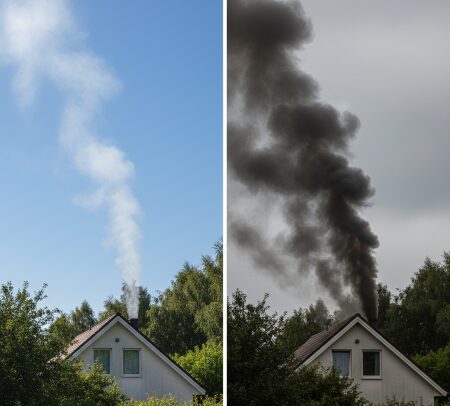
💨 Main causes of black smoke
The causes of thick black smoke from a chimney are often related to incorrect operation or technical faults.
1. Unsuitable or poor-quality fuel
Prohibited fuel: the most important and common cause. Burning unsuitable materials such as rubbish, plastic, treated wood or oil-soaked rags produces large amounts of soot and harmful chemicals.
Wet fuel: when wood or pellets are too wet, energy is used to evaporate water instead of supporting combustion. This cools the combustion chamber, slows combustion and makes it incomplete, resulting in more soot.
2. Insufficient air (oxygen)
Incorrect settings: combustion needs an optimal fuel-to-air ratio. If the boiler does not receive enough air (the fan speed is too low, air vents are closed or too much fuel is being fed), the fuel burns slowly and incompletely.
Blocked passages: clogged air filters, closed boiler-room vents or blocked boiler channels.
3. Condition of the heating system
Blocked chimney or flue: when a chimney contains soot, ash and creosote, the draught weakens. Poor draught means insufficient air supply, which again leads to inefficient combustion. Creosote is a particularly dangerous flammable deposit that can cause a chimney fire.
Dirty boiler: dirty heat-exchanger surfaces or a dirty burner interfere with proper heat exchange and air circulation.
Technical faults in pellet boilers: faulty airflow sensors or fans can directly cause an incorrect fuel-to-air ratio, which is controlled by the automation system.
🛠️ What should you do if you see black smoke?
First and foremost, respond immediately to reduce the risk of fire and more serious faults.
1. Immediate safety measures
Stop burning unsuitable fuel: make sure you use only permitted, dry and good-quality fuel. Never burn household rubbish or plastic!
Risk of poisoning: black smoke signals a high level of CO (carbon monoxide). Check your CO detector and ventilate the rooms.
2. System inspection and maintenance
Clean the boiler: thoroughly clean the ash pan, burner and heat-exchanger surfaces. Regular boiler maintenance is essential for efficient operation.
Chimney cleaning: if the chimney is blocked, call a professional chimney sweep immediately. The chimney should be cleaned regularly in accordance with fire-safety requirements (depending on fuel type, at least once every 3–12 months).
Check the air supply: make sure the boiler has enough fresh air supplied to the boiler room.
3. Pellet boiler adjustment and repair
In an automatic heating system, black smoke indicates an incorrect fuel-to-air ratio.
Adjusting the fuel-to-air ratio: try reducing the fuel feed or increasing the airflow (fan) through the boiler controller. This requires precision.
Calling a specialist: if adjustment does not help, the fuel-feed auger, fan or sensors may be faulty. It is best to call a pellet boiler repair specialist for a technical inspection and accurate adjustment.
If you suspect a technical problem, you can contact specialists, for example those listed in our information:
Phone: +370 61707422
Address: Mindaugo g. 1, Trakai, 21115, Lithuania
💡 Summary
Transparent or white smoke (water vapour) indicates good combustion. Black smoke means incomplete combustion, fire risk and pollution. It requires immediate boiler cleaning, chimney maintenance and, if necessary, adjustment of the boiler’s technical settings.